European B2B Platform: Fragmented Workflows to One System
A B2B company operating across several European markets ran product data, customers, inventory, quotations and orders in disconnected tools. We built one central platform that connects the customer portal, catalogue, inventory, ERP, payment and logistics, with multilingual content and regional configuration.
Direct answer. A B2B company selling in several European markets was running quotations, inventory and orders across spreadsheets, email and an ERP owned by a third party. We built one central B2B platform that connects the customer portal, catalogue, inventory, ERP, payment and logistics. Each piece of data has a single owning system, and the ERP integration is built to survive delays, retries and inconsistent data.
European B2B software development case study: from fragmented workflows to one reliable platform
The client operated across multiple European markets. Product data, customer records, inventory, quotations and orders lived in separate tools that did not talk to each other. The new platform puts the customer-facing portal and the back-office systems on one footing. It is multilingual and configured per region.
The problem: quotes in email, stock by hand, orders out of sight
Quotations were assembled in spreadsheets and sent by email. Inventory was updated manually. Once an order reached the ERP, its status was hard to follow. There was no single source of truth. Each market had its own language, tax and workflow rules on top of that. When an integration failed, nobody could reliably reproduce what had happened.
Constraints we worked within
Operations stayed live the whole time, so development could never require a stop. European privacy requirements applied to customer and order data. The ERP belongs to a third party: the platform cannot change it, and has to cope when it responds late or returns data that does not match. An audit trail was required. And anything said publicly about the project, including this page, stays within what the evidence supports.
How we approached it
1. Data ownership came before any screens
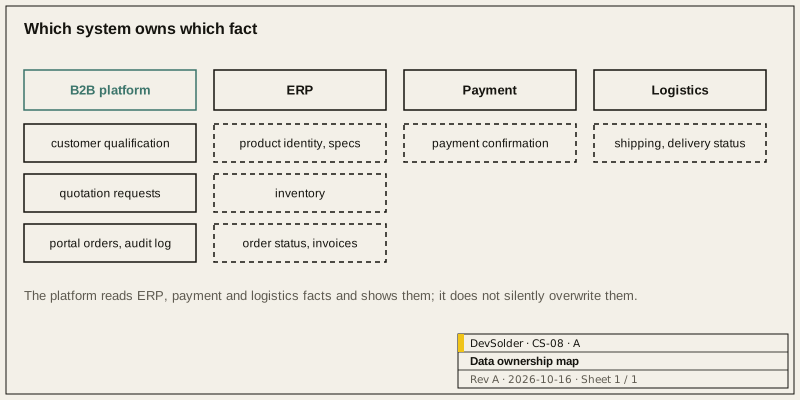
Before designing the portal we agreed which system owns which fact: product identity and specifications, inventory, customer qualification, order state, payment confirmation, shipping and invoices. This came first because most of the original trouble came from two systems both believing they were right. With ownership written down, the platform reads what the ERP, payment and logistics systems own and displays it, and it never silently overwrites ERP or logistics data.
2. A portal for business customers
Companies register and go through a qualification review before they can buy. They browse products and stock, see customer-specific prices, request quotations, place and track orders, and find invoice and delivery information in one place. Behind it sit the admin tools and audit records the operations team works with.
3. An ERP integration layer that expects things to go wrong
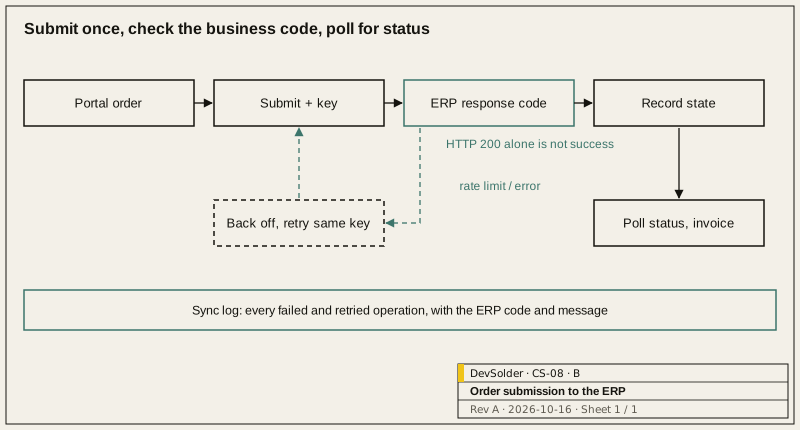
The integration uses token authentication with bearer tokens, a consistent request envelope and standard responses, and paginated inventory sync. Orders are submitted idempotently, so a retry after a timeout cannot create a second order. Status and invoices are fetched by polling, with backoff when the ERP rate-limits, and every error and retry is logged.
One rule matters more than it looks: an HTTP 200 from the ERP is not treated as success. A transport-level “OK” only says the request arrived; the ERP can still reject the order in its own response code. The platform reads that code and records the business state, so “sent” and “accepted” are never confused. Our field note on ERP order sync covers the same pattern in more detail.
4. Built for European operations
Content is multilingual, settings are regional, and dates and times use European formats. Access is role-based, each role sees only the data it needs, and actions are written to an audit log. We treated privacy as an input to the architecture rather than a review at the end.
5. A release gate built on real scenarios
Before a release, changes are run against concrete scenarios: registration and qualification, product and inventory sync, quotation and order submission, payment confirmation, delivery status, invoice retrieval, and integration failures with retries. Each change is also reviewed against the systems it touches.
What exists now
- One central platform in place of disconnected tools.
- A documented ERP integration contract.
- Local and integration tests that can be rerun on every change.
- Structured sync logs for every failed and retried operation.
- A clear split between data the platform owns and data the ERP owns.
- A structure that can take on more countries, languages and sales channels.
Limits of this case study
Client identity, the ERP vendor and commercial data are withheld under NDA. No revenue, conversion or cost-saving figures are claimed. The platform supports privacy-aware processing; legal review, policies and operational controls remain the client’s responsibility.
If you run B2B sales across markets and your ERP is the system of record, see our services and web and cloud work, or discuss a project with us.
Frequently asked questions
Why build a custom B2B platform instead of adding more tools?
The problems sat between the tools: quotes in email, stock updated by hand, order status buried in the ERP, and different language, tax and workflow rules per market. Another tool would have added one more copy of the data. A platform built around clear data ownership could connect the existing systems instead of competing with them.
How was the ERP integration handled?
Through a controlled integration layer with a documented contract: token authentication, request envelopes and standard responses, paginated inventory sync, idempotent order submission, and polling for status and invoices with backoff on rate limits. The platform checks the ERP's own response code rather than trusting HTTP 200, records the business state, and logs every failed and retried call.
Was it designed for several European markets?
Multiple markets were a design input from the start. Content is multilingual, settings are configured per region, dates and times follow European formats, and access is role-based with audit logging. Adding a country, language or channel builds on the same structure rather than a separate copy.
What makes the platform reliable in practice?
Mostly decisions about failure. Each fact has one owning system, order submission can be retried without creating duplicates, ERP responses are checked at business level, and failed or retried operations end up in structured sync logs. Changes are tested against scenarios that include integration failures before release.
What kinds of companies can use this approach?
European distributors, wholesalers, manufacturers and B2B service companies, especially those whose orders, stock or invoices already live in an ERP they cannot replace.