Paid Discovery Scope Template
Scope template for a paid discovery on a device project: inputs, activities, five outputs and exit criteria, ready to copy into your own document.
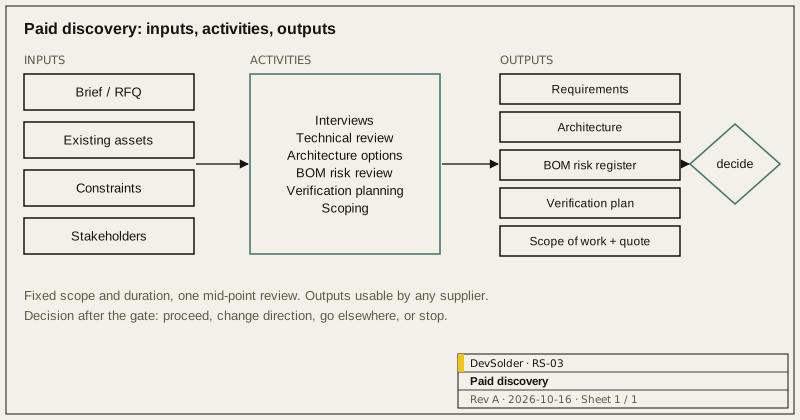
Direct answer. A paid discovery turns an idea or a partial design into something that can be quoted firmly. It is a fixed-scope engagement that produces five outputs: requirements, an architecture, a BOM risk review, a verification plan and a scope of work for the next stage. This template lists the inputs, activities, outputs and exit criteria to agree before it starts.
1.0 When a paid discovery is the right first step
A firm quote needs firm inputs. When too many items on an RFQ are still unknown, any fixed price either carries a large contingency or hides assumptions that will become change requests. A discovery resolves the unknowns first which is usually cheaper than correcting the main project after it has started.
It is usually the right step when:
- Requirements exist as a description or a slide deck, not as a specification.
- The choice between architectures (for example, which processor, which radio, which split between device and cloud) has not been made.
- An existing design or codebase needs to be assessed before deciding what to change.
- The project has both hardware and software parts and their interfaces are not defined.
When the requirements and design are already clear, a discovery adds little; a technical review or a direct quote is the better route.
2.0 Template: scope of a paid discovery
Copy the sections below into your scope document and fill them in with the supplier.
2.1 Purpose
One paragraph: what decision this discovery must make possible. For example, “Decide whether to build the device on platform A or B, and produce a scope and quote for the prototype stage.”
2.2 Inputs from you
| Input | Provided | Notes |
|---|---|---|
| Product brief or RFQ checklist | yes / no | |
| Existing designs, code, prototypes | yes / no | Revision, handover state |
| Target markets and certifications | yes / no | |
| Cost, size and power constraints | yes / no | |
| Volume estimate as a range | yes / no | |
| Access to stakeholders (product, engineering, operations) | yes / no | Names and availability |
| Decisions already made and not open | yes / no |
2.3 Activities
| Activity | Description |
|---|---|
| Kick-off and interviews | Clarify use cases, constraints and priorities with each stakeholder |
| Technical review of existing assets | Read design files and code; build or power existing prototypes if available |
| Architecture options | Two or three options with trade-offs: cost, risk, effort, sourcing, power |
| Component and BOM risk review | Lifecycle, sources and alternates for key parts in the preferred option |
| Verification planning | What must be tested, how and when, including pre-compliance where relevant |
| Scoping | Break the next stage into work packages with estimates and assumptions |
2.4 Outputs
| Output | Contents |
|---|---|
| Requirements document | Functional and non-functional requirements, priorities, open questions |
| Architecture | Block diagram, chosen option and the reasons, interfaces between hardware, firmware and software |
| BOM risk register | Key parts with lifecycle, source count, alternates and mitigations |
| Verification plan | Test list per requirement, test method, equipment, responsible party |
| Scope of work and quote | Work packages, deliverables, acceptance criteria, assumptions, schedule, price for the next stage |
2.5 Exclusions
List what the discovery does not include, such as detailed schematic design, firmware implementation or certification testing. Being specific prevents the discovery from turning into the project.
2.6 Schedule and reviews
Agree a fixed duration and at least one mid-point review where the architecture options are presented, so your team can steer before the final outputs are written.
2.7 Exit criteria
The discovery is complete when the outputs in 2.4 are delivered and reviewed, and open questions are either resolved or listed with an owner. The decision that follows is yours: proceed with the same supplier, take the outputs elsewhere, or stop.
2.8 Example scope paragraph
A short example of how the filled-in template can read, with placeholders in brackets:
This discovery will decide the architecture for [product] and produce a scope and quote for the prototype stage. Inputs are the product brief dated [date], the existing prototype at revision [rev], and interviews with [roles]. Activities cover technical review of the prototype, two or three architecture options, a BOM risk review of key parts and a verification plan. Outputs are the five documents listed in section 2.4. Schematic design, firmware implementation and certification testing are excluded. The discovery runs for [duration] with a review at the mid-point and ends with a presentation of the outputs.
Keep the scope to one page if possible. A long scope for a discovery is often a sign that the discovery is trying to be the project.
3.0 What makes a discovery useful
- Any competent supplier can work from the requirements, architecture and scope, not only the one who wrote them.
- Each trade-off ends in a recommendation with reasons; your team makes the final call.
- Every estimate in the scope of work lists what it assumes.
- The discovery has its own fixed scope and price, so it cannot turn into the project.
4.0 Where this fits in the service ladder
The DevSolder service ladder runs Technical Review, Paid Discovery, Software Build or Hardware Design Package, Prototype Bring-up, Pilot / Rescue, Productization / NPI and Support. A discovery usually follows a technical review and leads into software build, a hardware design package or both.
Related pages: Software Development, Hardware Design, Prototype to Production. Use the RFQ checklist to prepare inputs, and start through Discuss a Project.
Frequently asked questions
Why pay for discovery instead of getting a free quote?
A free quote can only be as good as the information behind it. When key decisions are open, the work of making them is real engineering. Paying for it gets you outputs you own and can use with any supplier, and a quote for the next stage that rests on agreed requirements.
Can we take the discovery outputs to another supplier?
The outputs are written so that any competent supplier can use them. Ownership terms for the documents are agreed in the scope before work starts.
How long does a discovery take?
It depends on the size of the product and how much already exists. The duration is fixed in the scope before starting, with a mid-point review, so it does not drift.
What if the discovery shows the project is not feasible?
That is a valid result, and a cheaper one to reach in discovery than after a prototype. The report explains why, and what would have to change, such as cost targets, size or timing, for the project to become feasible.
Does a discovery commit us to the next stage?
The discovery ends at a decision gate, and nothing after it is committed in advance. You review the outputs and the quote for the next stage, then choose to proceed, change direction, take the documents to another supplier, or stop. The scope document should state this explicitly.