RFQ Checklist for Device Projects
What to prepare before asking for a quote on a device project: goals, constraints, existing assets, quantities, responsibilities and acceptance criteria.
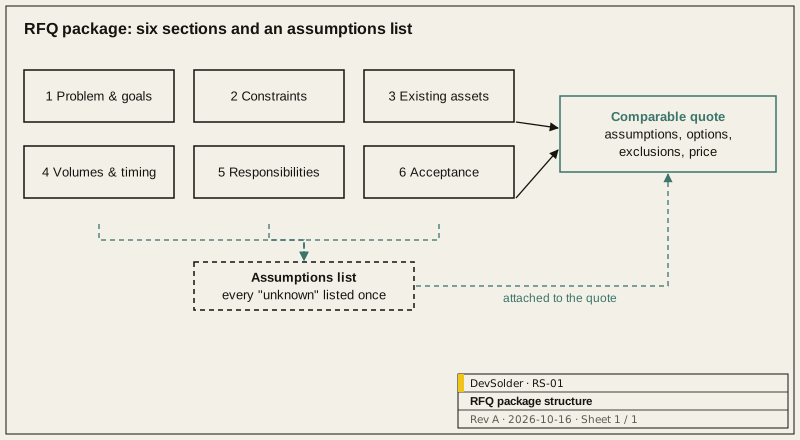
Direct answer. A useful request for quote describes the problem, the constraints, what already exists, expected quantities, who does what, and how the result will be accepted. You do not need every answer. Mark unknowns as unknown; a quote built on stated assumptions is easier to compare than one built on guesses.
1.0 How to use this checklist
Copy the tables into your own document and fill in what you know. Leave a cell as “unknown” or “to be decided” rather than guessing; a supplier can then quote the uncertain items as options or propose a paid discovery to resolve them. Send the same document to every supplier you ask, so the quotes can be compared.
Do not include confidential material in a first enquiry. A description of the problem is enough to judge fit, and detailed files can follow under an NDA.
2.0 Problem and goals
| Item | Your answer |
|---|---|
| What the product does, in two or three sentences | |
| Who uses it and where (indoor, outdoor, industrial, medical, consumer) | |
| What triggered this project now | |
| What success looks like at the end of this engagement | |
| What is explicitly out of scope |
3.0 Constraints
| Item | Your answer |
|---|---|
| Target unit cost or cost ceiling, if known | |
| Size, weight, enclosure constraints | |
| Power source and runtime expectations | |
| Connectivity (BLE, Wi-Fi, cellular, USB, wired fieldbus) | |
| Operating environment (temperature, ingress, vibration) | |
| Target markets and the certifications you expect to need | |
| Preferred platforms, toolchains or suppliers you must use | |
| Fixed dates (trade show, pilot, regulatory submission) |
Certification testing is done by an accredited lab you choose. Listing target markets early matters because it affects part choices and layout.
4.0 What already exists
| Asset | Status |
|---|---|
| Requirements or product spec | none / draft / approved |
| Schematic and PCB | none / prototype / in production |
| Firmware source | none / partial / complete, with build instructions? |
| App, cloud or back-end software | |
| Prototype units available for testing | how many, which revision |
| Previous supplier work and its handover state | |
| Known problems and field reports |
5.0 Volumes and timing
| Item | Your answer |
|---|---|
| Prototype quantity | |
| Pilot quantity | |
| Expected annual volume, as a range | |
| Desired timing for each stage |
Volume matters even for design work: it changes component choice, test strategy and whether a fixture is worth building.
6.0 Responsibilities
Write down who you expect to handle each item. Common splits for device projects:
| Item | You | Supplier | Third party | Not needed |
|---|---|---|---|---|
| Requirements and acceptance criteria | ||||
| Electronics design | ||||
| Mechanical and enclosure | ||||
| Firmware | ||||
| App / cloud | ||||
| Component sourcing | ||||
| PCB fabrication and assembly | ||||
| Production test fixture | ||||
| Certification testing | ||||
| Import, customs and duties | ||||
| Field support after launch |
With DevSolder, hardware can be delivered as a Build-Ready Hardware Package that you source and build yourself, or we can arrange sourcing and assembly with an itemised quote. Importing, customs and duties are handled by you as importer of record, and certification testing is done by a lab you select.
7.0 Acceptance
| Item | Your answer |
|---|---|
| How each deliverable will be accepted (review, test, demo) | |
| Who signs off | |
| Test equipment or environment needed for acceptance | |
| What documentation you need at handover | |
| IP ownership and licensing expectations |
Custom work and licensed reference designs are handled under different terms. Say which you expect.
8.0 Assumptions list
Collect every “unknown” from the tables above into one list. A good quote answers each with an assumption, an option, or a proposal to resolve it during discovery.
8.1 Gaps we see in device RFQs
These are the items most likely to be missing, and each one changes the price or the plan:
| Gap | What it does to the quote |
|---|---|
| No acceptance criteria | “Done” gets negotiated at the end instead of agreed at the start. A list of tests and handover documents is enough to fix it. |
| Software scope implied by hardware | A PCB design request assumes firmware, a phone app or a factory test tool that nobody listed. |
| Update path not mentioned | If units take firmware updates in the field, the bootloader and the server side are part of the work. |
| Certification left for later | Radio, safety and EMC requirements affect part choice and layout, so target markets belong in the first brief. |
| Existing work without its handover state | “We have a prototype” can mean a working design with files, or a board without editable sources. Say which. |
8.2 How a supplier should respond
A good response to this checklist is as structured as the request. Expect, and ask for, the following:
| Element | What it should contain |
|---|---|
| Understanding | The problem restated in the supplier’s own words, so misunderstandings show early |
| Proposed approach | Stages, with what is decided at the end of each |
| Deliverables | Named documents, files and code per stage, with acceptance criteria |
| Assumptions | One line per unknown from your checklist |
| Exclusions | Work the supplier expects you or a third party to handle |
| Price structure | Fixed price per stage, time and materials, or a mix; external costs such as parts and boards listed separately |
| Risks | The main technical and schedule risks and how they would be handled |
If two responses differ a lot in price, compare the assumptions and exclusions first. That is where the gap tends to sit; hourly rates explain less of it.
9.0 Next step
When the checklist is mostly filled in, the Discuss a Project form takes the main points. If the volume, constraints or acceptance rows are still unknown, start with a Paid Discovery. Service pages: Software Development, Hardware Design, Prototype to Production.
Frequently asked questions
How much detail should the first enquiry include?
Enough to judge fit and give a rough range: the problem, constraints, what exists, quantities and timing. Detailed design files can wait for an NDA. A short, honest description with unknowns marked is more useful than a long one that guesses.
Why does the supplier need volume estimates for a design project?
Annual volume decides whether a bed-of-nails fixture pays off, which components are worth designing in, and how much effort goes into cost reduction. A range is enough.
Should we send the same document to every supplier?
That is the way to get comparable quotes. If each supplier receives different information, the differences in price may reflect the brief rather than the work.
What if we do not know the answers yet?
Mark them unknown. Uncertain items can be quoted as options, or resolved in a paid discovery that produces the requirements, architecture and risk list needed for a firm quote.
Can the RFQ cover software and hardware together?
It can, and for devices it should, because the interfaces between board, firmware and app are where scope gaps hide. Fill in the responsibilities table for both lines of work. DevSolder can quote them as one project or as separate pieces, and the software side does not require buying hardware from us.