A consumer app and consoles for a push-to-talk platform
A push-to-talk platform already running in the field served only hardware terminals. Without changing the terminal protocol, we added a consumer mobile app and consoles for three roles. Versions 1.0 and 1.1 are both in production.
Direct answer. A push-to-talk platform already running in the field served only hardware terminals and had nothing for individual users. Without changing the terminal protocol, we added a mobile app and consoles for three roles. Version 1.0 went into production, and 1.1 went live on 2026-09-30.
Summary
The platform is a push-to-talk over cellular (PoC) service for sports and outdoor groups. Its services and radio terminals were already working in the field, so new features had to be added on top rather than rebuilt from scratch.
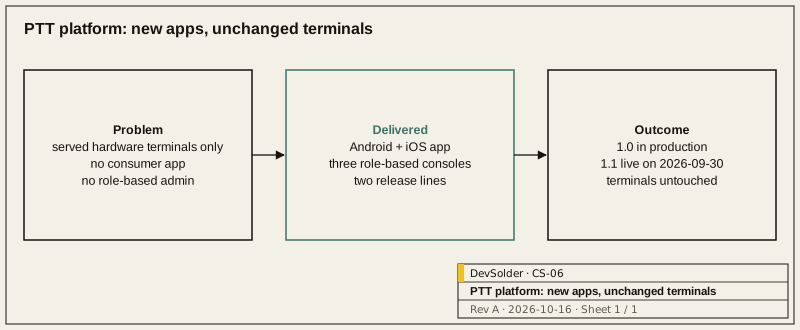
Problem
The existing platform provided accounts, groups, location, SOS and geofences for hardware terminals. It had no app for individual users and no separate consoles for the platform operator, resellers and sub-accounts. New features had to reach individual users without requiring any change to terminals already deployed, and production still needed ongoing fixes.
What we delivered
- A mobile app for Android and iOS, aimed at individual users.
- Three role-based consoles: platform operator, reseller and sub-account.
- A new business-service layer through which all new clients reach the platform, leaving platform interfaces and the terminal protocol unchanged.
- Two parallel version lines and a release process with verification, so production defects kept being fixed while the new version was developed.
Outcome
Version 1.0 went into production use, and 1.1 went live in production on 2026-09-30. No terminal in the field was changed at any point, and production fixes continued without interruption during new development.
Limits
User numbers, concurrency, voice latency and commercial results are not published. Client identity, product brand, hardware vendor and infrastructure details are withheld.
Frequently asked questions
Did the real-time voice protocol change?
The protocol is unchanged. Terminals already in the field and the voice path work as before; the new features sit on top of the existing platform, and no terminal needed an upgrade.
How was production protected while the new version was built?
Production maintenance and new development ran on two separate version lines. A verification step before each release confirms that the right build from the right line is going out, and production changes need an explicit release decision.
What technology was used?
Flutter for the mobile app on Android and iOS, Vue 3 for the consoles, and Java with Spring for the business services.