NPI Readiness Checklist for Electronics
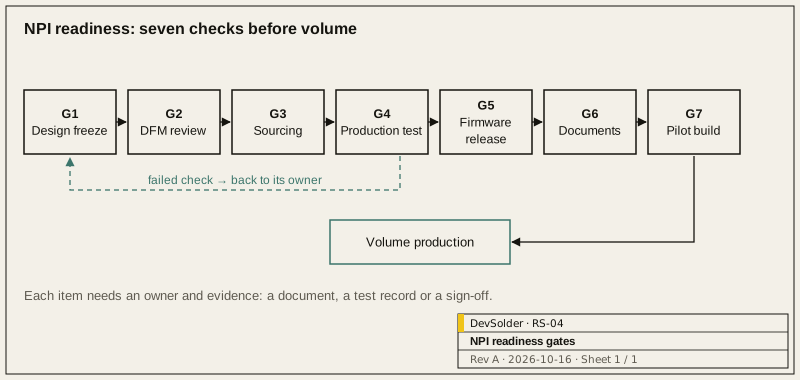
Checklist for moving an electronic product into production: design freeze, DFM, sourcing, production test, firmware release, documents, pilot build.
Direct answer. A product is ready for new product introduction (NPI) when the design is frozen under one revision, the board has passed a DFM review with the chosen manufacturer, key parts are sourced or covered by alternates, production tests run without the designer, firmware has a tagged release and programming procedure, and a pilot build has been completed and reviewed.
1.0 How to use this checklist
Each section is a gate with items to confirm. Assign an owner to every item and record evidence: a document, a test record, a sign-off. An item without evidence is not done. The checklist works for any manufacturing route: your own contract manufacturer, or sourcing and assembly arranged by DevSolder.
2.0 Design freeze
| Item | Evidence |
|---|---|
| Feature set agreed; remaining changes are cost or manufacturing driven | Signed requirement baseline |
| Schematic, layout, BOM, mechanical parts and firmware tagged under one revision | Revision tag and package index |
| All prototype reworks incorporated into the design | Issue list with each item verified on the latest boards |
| Known limits documented | Known-limits list |
| Change control process agreed for after the freeze | Written process: who approves, how revisions are numbered |
3.0 DFM review
| Item | Evidence |
|---|---|
| Board checked against the fabricator’s capability document for the chosen process | Review record with document revision |
| Assembler’s DFM feedback received and resolved | Feedback list with resolutions |
| Panelisation and depaneling agreed | Panel drawing |
| No steps that relied on hand rework or hand assembly in prototypes, or they are documented as process steps | Assembly notes |
| Mechanical fit verified with production-intent enclosure parts | Fit check record |
4.0 Sourcing
| Item | Evidence |
|---|---|
| BOM risk register up to date for this build | Dated register |
| Long-lead and single-source parts ordered or allocated | Purchase records or allocation confirmation |
| Approved alternates listed in the BOM | BOM revision |
| Moisture-sensitive and pre-programmed parts handling agreed with assembler | Assembly notes |
| Export and import requirements checked for parts and finished goods | Notes from the check, with date |
5.0 Production test
| Item | Evidence |
|---|---|
| Test coverage table: each subsystem, test method, station | Coverage table |
| Test procedure written for an operator, with pass/fail limits | Procedure document |
| Fixture built and validated, if used | Validation record using known-good and known-bad units |
| Test results recorded per serial number | Example records from pilot |
| Failure handling defined: retest, repair, scrap, and who decides | Written process |
6.0 Firmware release
| Item | Evidence |
|---|---|
| Production firmware tagged and built reproducibly | Tag, build instructions, checksum |
| Debug and factory commands disabled or locked in production builds | Code review note |
| Programming procedure for the line, with verification of the programmed image | Procedure document |
| Device identity, keys or serial numbers provisioned per unit, if needed | Provisioning procedure |
| Field update path tested on production hardware | Test record |
7.0 Documentation
| Item | Evidence |
|---|---|
| Manufacturing package matches the frozen revision | Package index |
| Labelling and packaging specification | Drawing or specification |
| Certification test reports for target markets, completed by an accredited lab | Reports or test plan with dates |
| User-facing documents and regulatory markings as required by target markets | Document list |
| Service and repair notes | Document |
8.0 Pilot build
A pilot build runs the full process at small quantity, on the production line, with production parts, fixtures and procedures.
| Item | Evidence |
|---|---|
| Pilot quantity and goals agreed | Pilot plan |
| Yield and failure causes recorded | Pilot report |
| Every failure analysed, with root cause where found | Failure analysis log |
| Changes needed before volume production listed and approved | Change list |
| Sign-off to proceed | Signed record |
We do not suggest a target yield in this checklist. The right threshold depends on product cost, test coverage and volume, and should be agreed between you and the manufacturer before the pilot.
8.1 Common reasons a product is not ready
Patterns that show up when this checklist is applied honestly:
- Every prototype carries a bodge wire or a swapped resistor that never made it into the frozen files, so the pilot build produces boards that do not work.
- The production test passes only when the designer runs it. Written limits and an operator procedure catch this before the line does.
- The image on the line is whatever was last built on someone’s laptop. A release tag, a reproducible build and a checksum in the programming procedure close that gap.
- Sourcing was checked once, months ago. Recheck the register against the build quantity close to the order date.
- After the freeze, changes arrive by email and only some reach the factory. A written change process with numbered revisions stops that.
Fix these before the pilot build; after it, each one costs a second pilot.
9.0 Roles
Your contract manufacturer runs its own line and its own process checks; DevSolder can prepare the design, test procedures and documentation, work with the manufacturer’s engineers on DFM feedback, or arrange sourcing and assembly ourselves at itemised cost. Certification testing is done by an accredited lab you choose; local regulations, field safety and import formalities are handled on your side.
See Prototype to Production, Assembly, Bring-up and Test, Sourcing and Manufacturing and Embedded Firmware. To plan an NPI, start with Discuss a Project.
Frequently asked questions
When should we start NPI preparation?
Start while the prototype is still being refined, by involving the manufacturer in DFM review and planning production test. The freeze itself should wait until feature changes have stopped; freezing too early usually means freezing twice.
Do we need a pilot build if the prototypes worked?
Prototypes are usually built by the designers with care and rework. A pilot build tests whether the process works on the line with operators, fixtures and production parts, which is a different question.
Who owns the production test procedure?
The design side writes it, because it knows what can fail. The manufacturer runs it and should review it before the pilot. Both need to agree the pass/fail limits and how failures are handled.
Can NPI happen without a dedicated test fixture?
At low volume, manual testing with a clear procedure can work. As volume grows, a fixture usually pays for itself in time and consistency. The test points needed for a fixture should be on the board from the start, so that the choice stays open.
Who decides that the product is ready?
The product owner on your side makes the final call, based on the evidence collected against this checklist. The manufacturer confirms that its line is ready, and DevSolder confirms the design, test and documentation items we were responsible for. A short readiness review meeting with all three, going through the open items, is usually enough to reach a clear decision.