Integrating with Regulatory Reporting Interfaces: Mapping, Signing, Receipts and Resubmission
Direct answer. The hard part of regulatory reporting is not sending a request. It is three other things: each regulator’s message format differs and changes, receipts are often asynchronous, and both missed and incorrect reports have consequences. We split the work into three layers. Source data is first turned into internal standard objects, then rendered into each regulator’s message for a given specification version. A shared sending layer handles signing, encryption, retries and receipts. Every report and receipt is kept as an audit record, with defined resubmission and reconciliation procedures.
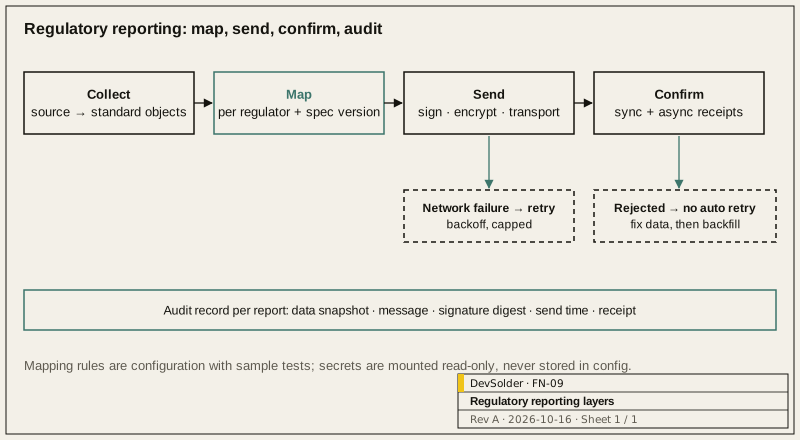
1.0 Separate format from delivery
The usual legacy pattern is one service per region, with field mapping, signing and sending all hard-coded. Every specification change means a release, the regional services drift apart, and the same signing bug has to be fixed several times.
A sturdier structure layers the work by how often it changes:
| Layer | Responsibility | Changes with |
|---|---|---|
| Collect | Pull data from company systems and convert it to internal standard objects | Company systems |
| Map | Standard objects to the message for one regulator and one specification version | Specification versions |
| Send | Authentication, signing, encryption, transport, receipts, retries | Rarely |
Mappings are managed per regulator and specification version. When a new version goes live the old one remains, the switch happens on the effective date, and rolling back means changing the date.
2.0 Mapping as configuration, with tests
Mapping rules are configuration: field correspondence, code-table conversion, unit conversion and required-field checks. Implementation staff maintain them in a UI rather than in code. Configuration can be wrong too, so:
- Each mapping has a set of sample data and expected messages, compared automatically after every change.
- Code tables, such as industry codes and administrative regions, are versioned separately and referenced by version.
- Configuration changes go through approval and are logged, so you can see who changed what and when.
Some cases will never fit configuration. Give those exceptions a stable plugin interface instead of letting the configuration language grow into a programming language that implementation staff cannot maintain and developers would rather not touch.
3.0 The sending layer
- Certificates and keys are mounted read-only, never stored in the database or shown in the configuration UI, and rotation follows a written procedure.
- One runtime supports the transports regulators require, whether HTTP, long-lived TCP connections or a message queue, instead of a separate retry and logging stack for each.
- Each report carries a unique business serial number, and a resend reuses it so the regulator can deduplicate. If the regulator does not deduplicate, a local “confirmed” state is checked before any resend.
- A synchronous receipt usually means only “received”. The processing result arrives as an asynchronous receipt or has to be queried, and both paths are needed.
4.0 Retries, resubmission and reconciliation
| Situation | Handling |
|---|---|
| Network failure or timeout | Exponential backoff with a cap; beyond the cap, a manual queue |
| Rejected by the regulator’s validation | No automatic retry; the reason goes to the data owner and the corrected report is resubmitted |
| Reports missed during downtime | Resubmit by time window, with the reason recorded |
| Periodically | Reconcile against the regulator’s confirmations and list unconfirmed or mismatched items |
Retrying a validation failure achieves nothing except a stream of identical errors, and it may trip the regulator’s rate limits.
5.0 Audit
For each report, keep the source data snapshot, the generated message, the signature digest, the send time and the receipt. In a dispute you need to show what was reported at a given moment and what came back. Retention follows the regulator’s requirements and the company’s own compliance rules.
If you are replacing a hard-coded legacy reporting service or connecting to a new regulator, see Web, Cloud and Device Management, or discuss a project with us.
References
- Enterprise Integration Patterns, Guaranteed Delivery: https://www.enterpriseintegrationpatterns.com/patterns/messaging/GuaranteedMessaging.html
Frequently asked questions
Regional specifications change often. Can configuration really keep up?
Most changes add fields, update code tables or adjust validation, and configuration covers those. When the message structure or transport changes too, the mapping template or even the sending layer has to change. That is why mappings are versioned per specification and old and new versions run side by side, switched by effective date.
The regulator's test environment does not behave like production. What then?
That is common. We store every real receipt from integration testing, redacted, as a sample covering success, validation failures and each error code, and we reconcile more often after go-live to catch what the test environment never showed.
Can we start with a single region?
Starting with one region is sensible, as long as the structure is designed for several regulators: standard objects, mapping layer and sending layer kept apart. The second region then only adds a mapping instead of copying a whole service.
Our implementation staff do not write code. Can they maintain the mappings?
Day-to-day field mappings and code tables can be maintained in the UI, and every change is compared against sample data automatically, so a mistake shows up as a diff straight away. Exceptions that configuration cannot express are implemented by developers through a plugin interface.